Backspin: Wyclef Jean featuring Refugee Allstars — The Carnival (1997)
A musical masquerade. (86.5/100)

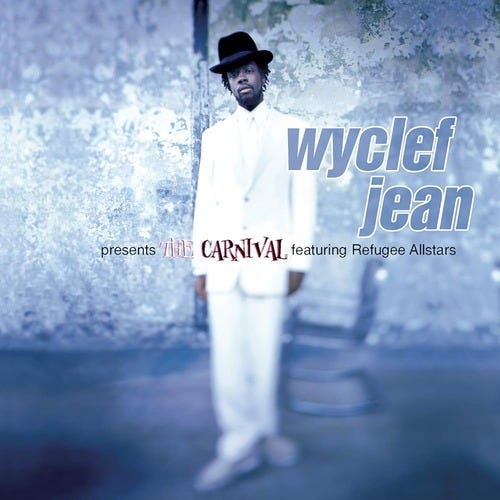
Originally published 7/13/25 on Medium.
There is no culturally richer time of year in Haiti than Carnival (Kanaval) season. Though brought to the Caribbean by European colonizers, the annual Spring festival was swiftly remixed by formerly enslaved Africans brought to Haiti as plantation labor. The free Africans infused Carnival with their music, spirituality, and cultural hallmarks. Today, Carnival remains an annual celebration of Haiti’s liberation and deep cultural lineage.
It’s fitting that Wyclef Jean would use The Carnival not just as the title of his sprawling solo debut, but as its sonic and thematic springboard. As the production guru and conceptual mastermind behind the multi-platinum Fugees, Jean touted his Haitian heritage as a super power from the moment the group introduced their Creole inflected “Vocab” to the world.
If Haiti anchored Wyclef’s spirit, the streets of crack era Newark, NJ, where he spent his formative years, shaped his sensibility. Just as the Fugees’ 17 million selling sophomore breakout, The Score, ruminated at the intersection of the two worlds, The Carnival, owes as much to the macabre showmanship of American small c “carnivals” as to Haiti’s deeply rooted tradition. The result is a long-player as fantastically entertaining as it is culturally dense.
The Carnival commences with a multi-tiered intro framing the album as a “trial,” The U.S. government setting out to prove that Wyclef is nebulously “not innocent.” We’re introduced to the cast who will be performing the forthcoming songs and skits, highlighting the inherent facade of the proceedings. Finally, Clef himself grabs the bullhorn, announcing that “we are not stopping for no red lights tonight.” His theatrical barking is cut short by the hauntingly operating voice of a sampled Danielle Licari ushering us into the dystopic fun house of “Apocalypse”.
When the drums stampede into the mix, the rapturous opener juxtaposes fantastical highs and crushing reality checks. Clef goes from basking in the majesty of his newfound celebrity to being hunted by law enforcement in the space of a few bars.
I was on the highway pushing a black Viper
A car pulls up, is he a jacker or a sniper?
A blue Range Rover, he says, “Pull over!”
I didn’t know he was a DT undercover
I screamed out my lungs, “This is discrimination!
What’s the charge?” He said, “You just robbed a gas station”
Who me? Not me, It couldn’t be
I was at the Grammys with Brandy, didn’t you see me on TV?
Ending with Clef operatically envisioning his terminal blaze of glory, “Apocalypse” establishes the album’s tone of revelry in the existential terror of encroaching end times. In revisiting the album, it’s hard not to be struck by just how much darkness lurks beneath the vibrant soundscapes, and how much joy Clef finds in embracing that darkness.Even the most celebratory tracks crackle with an acknowledgement of the depravity inherent their world and the masks its inhabitants must wear to maneuver it.
On a sensual reimagining of the Cuban patriotic standard “Guantanamera,” Wyclef and Fugee-mate Lauryn Hill paint contrasting portraits of a young woman deftly wielding the many masks of her sexuality. Clef opens the track with a surreal romanticization of that rapturous moment when the right woman, the right music, and the magic of the night conjure spirits of nostalgia and possibility. Upon his conquest, he projects his warmest memories (“Remind me of an old Latin song that my uncle used to play on his old 45, when he used be alive”) and idealized fantasies (“A penny for your thought, a nickel for your kiss, a dime if you tell me you love me”).
After a passionately delivered verse from the original, courtesy of its most famous crooner, Celia Cruz, Lauryn brings Clef’s romanticism crashing back to earth. Her grim depiction of a second generation immigrant making her way through an unforgiving world with the only currency she possesses accentuates the ominousness of Clef’s brooding guitar chords.
The carnival of love turns unsparingly personal on “To All the Girls”. The song’s uneasy reconciliation of a love triangle adds another layer to the album’s themes of masks and dualities. However, subsequent revelations of Clef and Lauryn’s secret affair shortly after the start of his marriage retroactively rip off the masks to reveal one of The Carnival’s most nakedly unaffected moments. One of the album’s few sonically subdued offerings, “To All the Girls” resists melodrama in favor of stark resignation. The heart wants what it wants, and its affairs will end how they end.
The album’s overarching ethos is perhaps best captured in the roisterous second single, “Anything Can Happen.” Atop a dizzying calypso seasoned groove, Clef vacillates from playful to philosophical in unpacking the razor’s edge upon which existence hangs. The song colorfully evokes the sudden twists of fate that can take a reckless playboy from a married lover’s bed to the trunk of a car in the space of minutes, or a musician from afterthought to headliner with one hit. Clef ultimately chooses to embrace the excitement and danger that represent two sides of an ever spinning coin.
Don’t get souped cause you pushin’ a coupe
Next year you on foot, runnin’ from a lawsuit
For example, I know I’m nice, I don’t flaunt it
Least anticipated, to the most wanted
Soaring strings from the New York Philharmonic lend “Gone ’Til November” an angelic veneer, martyring road warrioring hustlers traversing highways and borders in chase of elusive fruits of forbidden labor. The ethereal beauty infused by the global hit is short lived. The Carnival’s back half grows increasingly foreboding in its portrayal of life’s shadows and all that lurks within them.
“Year of the Dragon” and “Sang Fezi” offer back to back meditations on the suddenness with which brutality can upend life’s seemingly easy rhythms. The former finds Clef and Lauryn trading vividly rendered verses over a slyly deployed guitar loop from The Police’s “Voices Inside My Head” and a funhouse recreation of George Kranz’s “Din Daa Daa.” The sonic dissonance evokes social decay of a global order.
On the latter, Clef flexes a stoically somber delivery. His Kreyòl lyrics of Haitian pride are juxtaposed against imagery of a nihilistic dystopia justifying the song’s chorus, loosely translated to “Which Haitan says I walk around New York without my gun?/I tell you man, ya’ll lyin’/When the bum catches you they eat you up/It’s when you die the police come”. Lauryn’s soulfully sung coda closes the track on an inspirational note. Yet, set against the production’s dark chords and ominously repetitive bassline, it feels more like a prayer before the war than a hymn of salvation.
The creative alchemy between Wyclef and Lauryn offers a tantalizing hint at what could have been had the messy demise of their romantic relationship not rendered the Fugees a casualty of love’s carnival. It’s also a peek behind the curtain as to why the affair was likely inevitable.
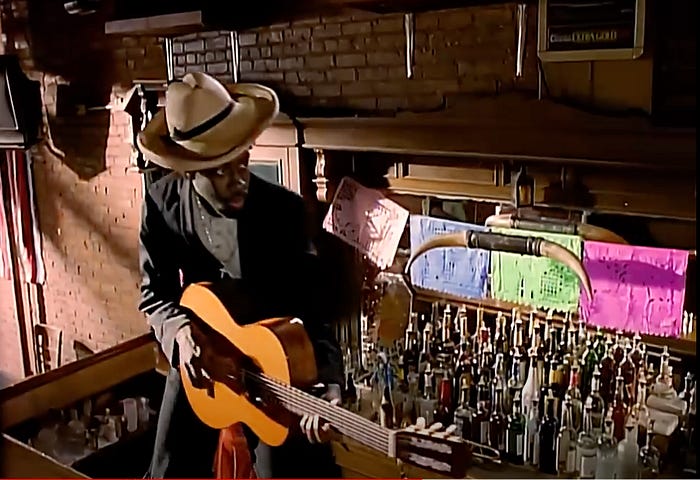
“Guantanamera” music video. Screen capture by authout. Video from Wyclef Jean on YouTube.
“Street Jeopardy” opens with a short, but telling, skit in which Clef adopts the persona of a music executive urging an unsuspecting artist to deliver “more gangster, more blood, more gun talk, more people dying.” It’s a poignant reminder that, in a hip-hop world still reeling from the murders of Tupac Shakur and the Christopher “The Notorious BIG” Wallace, the industry was cynically scrambling to reap whatever dollars remained from the romanticized version of the violence that claimed them.
The song responds with a darkly cinematic illustration of the real world ripple effects of urban warfare packaged as entertainment. Clef and R.O.C. both compliment eery guitar chords with stellar verses, but its John Forté who delivers the true standout performance. His excoriation of a prison industrial complex in which “..every cell in the bing had a tenet/With each of them regrettin’ they was in it” lands even more hauntingly in light of his own 2000 arrest and 8 year incarceration for drug trafficking.
By the time the propulsive guitar and airy falsetto of the Bee Gee’s disco classic “Stayin’ Alive” christens The Carnival’s lead single and surprise summer hit, “We Trying to Stay Alive,” the deep grooving dance floor filler feels like a well deserved respite. In Clef’s hands (with spirited assists from Forté and Fugees’ Pras), the ode to nightlife opulence transforms into an exultation of doing whatever it takes to not only live another 24, but actually stay alive, be it through music, revelry, or community.
The flight of fancy crashes back to the runway just as quickly as it launches. Slow beating Nyabingi drums and mournful acoustic guitar chords set the stage for a haunting close to the album’s main program. “Gunpowder” is a plaintively minimalistic island folk ballad in which Clef finally allows himself the space to mourn those lost amid the dizzying nihilism behind the carnival’s spectacle and illusion. His depiction of a brother killed during the Haitian Intervention of the mid-90s conveys a sense of purpose lacking from the urban warfare depicted throughout the album. However, both feel a part of a larger carnival careening out of control, its masks representing grotesque manifestation of what lies underneath.
That the scope and proficiency of The Carnival landed as a surprise in 1997 reflects more on our perceptions of Wyclef than it does on him. Even after the outsized success of The Score, there was still prevailing sentiment that Hill was the bell cow and, in Clef’s words, “the guys should stop rapping, vanish like Menudo.” In reality, Clef’s boundary-busting production and conceptual vision were the engine that powered the trio, even if Hill’s high wattage charisma and lyrical gravitas provided the power steering.
Hill’s 1998 The Miseducation of Lauryn Hill proved one of music’s greatest albums. However, The Carnival, featuring ample contributions from Hill, Pras, and other extended Refugee crew members like Forté, is effectively the follow-up to The Score that fans have long lamented never receiving. Where its predecessor delivered a soundtrack to revolution behind the mask of radio friendly crossover hits, The Carnival is a spectacular masquerade. The masks offer outsized embodiments of the humanity beneath, even as they conceal motive and intention.
As with Haiti’s annual celebration, the album revels in the multitudes that define a culture, and ultimately humanity itself. It’s at once boisterous celebration and bitter lament; rebel yell and second line dirge. Eclectic soundscapes and unbridled third world pride enabled The Carnival to connect on a global level. Charting in 9 countries, not only did its success welcome future international artists into the hip-hop ecosystem, it pushed world music sounds into the lexicon of American hip-hop. Both seeds would bear increasingly rich fruit as the 21st Century progressed.
If The Score is under appreciated in the digital age, The Carnival has all but fallen out of the conversation entirely. Perhaps it’s a casualty of Hill’s skyscraper sized shadow crowding out all else Fugees. Maybe it got caught in the backlash that began when Hill cast Clef as Miseducation’s antagonist and metastasized as he became a ubiquitous hired gun producer in the 2000s (just ask Shakira’s hips).
Regardless, The Carnival now stands as a discarded gem, waiting to be marveled upon by future generations of miners rather than the singular opus that injected a much needed vibrancy into hip-hop at its most turbulent moment. That its erasure is as surprising as its initial success goes to prove its thesis.
When you’re rolling through the carnival, anything can happen.
By the Numbers
Production: 9
Lyrics (how the words are put together): 7.5
Delivery & Flow: 8
Content (Substance): 10
Cohesiveness: 9.5
Consistency: 9
Originality: 10
Listenability: 9.5
Impact/Influence: 8
Longevity: 6
Total — 86.5
Backspin is a look back at the albums that shaped and defined hip-hop. It explores what made them resonate, the impact they had on the culture, and where they fit in today’s ever-expanding hip-hop canon.
the haiti / newark double anchor reframes the whole album, and that line about revelry in the existential terror of encroaching end times is the carnival tradition in one sentence. clef leaning operatic, lauryn pulling it grim, that's the emotional architecture right there. been doing the same album retrospective format over at WID, illmatic was the first one. this is the bar.
Album still in rotation