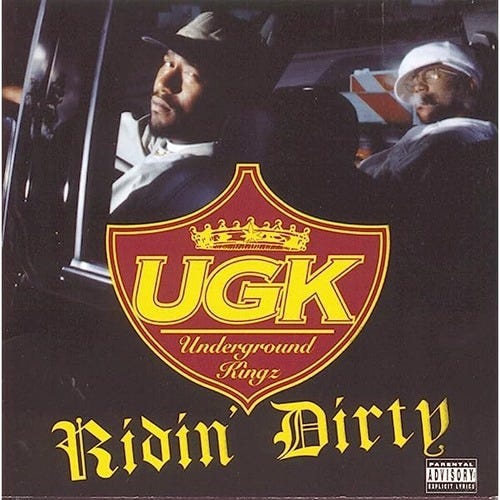
Backspin: UGK — Ridin’ Dirty (1996)
Underground overview. (91/100)

Originally published 6/15/24 on Medium.
It’s fitting that a duo named Underground Kingz would achieve their definitive classic with a release initially dismissed by their record label as a throw away.
Tension between Jive Records and UGK’s Bun B and Pimp C (okay, it was mostly the late Pimpin’ Chad) had grown so thick that despite the national buzz generated by the Port Arthur, Texas pair’s Menace II Society soundtrack hit “Pocket Full Of Stones” and the near-gold sales of 1994’s Super Tight, Jive Records dumped Ridin’ Dirty onto a crowded summer release slate without so much as a promotional single or music video.True to their name, UGK still connected with its core fan base by meeting them where they lived.
In the hustler’s parlance, “ridin’ dirty” refers to driving with illicit contraband stowed just out of view. The cleaner the car, the higher the likelihood of something dirty under the seat, in the glove compartment, or packing the stash box. That contraband represents the confounding duality of life in the shadows, equally capable of bringing fortune or disaster.
Ridin’ Dirty maneuvers the double-edged switchblade of that ambiguity, unspooling as a slow riding odyssey of the American underground in every sense of the term. It’s a palpable product of and homage to the underclass, the underworld, and the underbelly; a psalm for the under valued and overlooked.
In stark contrast to the characteristically aggressive openers that were a staple of ’90s hip-hop albums, “One Day” launches Ridin’ Dirty with a pensive meditation on the transience of lives lived out of view. Bun, Pimp, and Mr. 2–3 deliver vignettes of existence spent in eternal grind mode only to be ground to an abrupt halt by death and prison. In a bitingly bittersweet tone reminiscent of vintage southern blues, the MCs balance bleak fatalism with appreciation for moments shared with fellow soldiers taken too soon.
[Bun B]
I remember bein’ eight deep off in Chucky crib
Lettin’ us act bad, not givin’ a f*** what we did
When we lost him, I knew the world was comin’ to the end
And I had to quit lettin’ that devil push me to a sin
My brother been in the pen for damn near ten
But now it look like when he come out, man, I’m goin’ in
The pugilistic aggression of “Murder” reflects the raw intensity of a high stakes hustle in which time is the ultimate opponent. The track encapsulates Pimp and Bun’s impeccable chemistry. Pimp rhymes like a modern day blues man, his every extended inflection and vocal flourish embodying the underworld ethos he represents. Bun, by contrast, is a pure spitter. In a verse as torrid as the Texas air in August, he stacks syllables with surgical precision, riding the punishing MPC beat like a rodeo cowboy. If the former is making a killing in the streets, the latter is committing larceny on the mic.
“Pinky Ring” transports the microphone yin and yang onto a trunk rattling beat. It firmly orients the album on the hot concrete of the dirty south’s winding roads. You can feel the condensation settling into the vinyl seats of a classic Cutlass as the bluesy guitar licks nestle into the sinewy bassline.
“Diamond Wood”’s slow winding gangsta dirge deepens the sense of place. Its bluesploitation groove seemingly extends the ride of “Pinky Ring” into the after hours. The wheels of the whip and of the mind slow to a meditative roll, allowing Pimp and Bun to paint palpable pictures of their world, shaded with deadly characters and ethical cul-de-sacs.
[Pimp C]
Pooh say he goin’ through a thang, when y’all ain’t never lied?
I got a baby, but his mama act like he ain’t mine
Wicked women using children to live on
Wanna hurt and try to hate, ’cause she know the thrill is gone
Say, man, I stopped smokin’ with haters back in ‘94
But n****s thinkin’ that a Sweet gonna get ’em through my door
And n****s talk a lot of s*** in a safe place
I know ’cause he can’t look me eye-to-eye when he in my face
Now, n****, listen to my beats and see just what I mean
N****, I ride dirty every day, but still I shine so clean
Glitter and gleam ain’t all what it look like
So I keep swangin’ out here, clangin’, tryna live my life
If the codeine drenched chords of “Diamond Wood” invite thoughts to roam, the next two tracks re-establish the immediacy of late night journeys where danger lurks around each corner. “3 In The Mornin’” evokes an open air fun house haunted by predatory feds, envious local law, Columbian assassins, and two-timing corner boys all angling for a larger piece of an ill-gotten pie. “Touched” pulls back the veil of stoicism providing a veneer of unhurried cool to a dirty ride through a nihilistic ecosystem. In this world, getting “touched” with unchecked emotionality generally leads to getting “touched” with hands or worse.
The B Side kicks off with a pair of tracks speaking to integral components of the underground, that are equally prevalent throughout American culture. Too $hort homage “F*** My Car” rides an ascending guitar riff that revs like a muscle car engine. Pimp and Bun lay bare the gratification, pitfalls, and ultimate contradictions of a car culture that stands in for consumerism. Beneath a candy coating of ribald humor, the rhymes presents a corrosive circularity in which men use cars to entice women, only to resent women for being lured by cars.
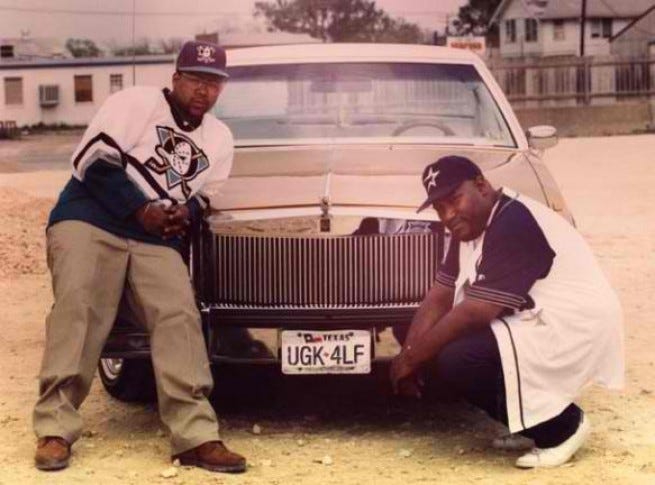
“That’s Why I Carry” extends the car motif. The narratives springboards from Bun’s opening vignette of a high roller getting jacked into a full-throated embrace the Second Amendment remedies that are as intrinsic to the American mythology today as when the song (and the Amendment) was written. Though Pimp’s verse warns of the perils of gunplay (“when you bust on your boy, neither one of ya’ll n****s win/You end up killin’ somebody you really ain’t wanna kill”), he makes the song’s ultimate thesis clear: “When I pull, I always pop, that’s why I’m livin’ today.”
Musically and lyrically, the album’s themes culminate in the show stopping “Hi-Life.” Cool grooves and a soulfully funkafied chorus are offset by pensive strings and a somber church organ embodying both the thrill and threat omnipresent in a life chosen by and for so many. Lyrically, the MCs lean on the dry irony native to the region’s vintage blues to highlight the punishing lows endured to sustain the “hi-life.” Despite a 5:25 runtime, the track contains only two verses, giving the MCs a broad canvas on which to sketch a hauntingly nuanced portrait of futile brutality.
[Bun B]
Streets’ll eat your ass alive
Take your possessions with pistols, bare hands, and knives
And nobody’s surprised, if somebody don’t survive the dusk to see dawn
It’s treacherous how we was left here to just die on these streets that we be on
Motherf***ers sleeping on them corners that you pee on
Probably ’cause society felt they didn’t belong
Now who in the f*** made it this way for us?
Got all these little n****s sellin’ that yay
Because it ain’t like they make higher levels gainable
And that quote “piece of American pie” just ain’t attainable
So how can I sustain a full life before death?
Man, I’m left out here to make it by my goddamn self
The guitar drenched title track rounds out the journey like a slow sun rise. We’ve made it through another night in the unseen underbelly. The facade of civilization is returning, and with it the easy bop of a hustler with a full knot and at least another 24 in which to enjoy it. After a 50 minute guided tour through the grime behind the glamour in which underground kings bask and their subjects revel, it feels like a hard earned, if ultimately hollow, victory lap.
In the context of UGK’s career, Ridin’ Dirty proved an equally slow roll, if ultimately more resounding victory. Despite moving just 67,000 copies in its first week, mostly in the South, the album now sits at just under 900,000 in sales. It’s routinely cited as an influence by hip-hop legends from all regions. The album reportedly became a favorite of Tupac Shakur near the end of his life after UGK’s fellow Texan, Scarface, slid him a cassette. Jay-Z was clearly listening — he incorporates Bun B’s “Touched” bars into his now-legendary “99 Problems.”
The wide embrace of Ridin’ Dirty speaks to the power of its authenticity at a moment when hip-hop was becoming the domain of increasingly grandiose production and outsized characters. Pimp C and a largely uncredited N.O. Joe incorporate the sophistication of West Coast G-Funk, but the mixes are left raw and intimate. The pair’s interspersion of live instrumentation channels the world weary grit and dogged determination of the blues and soul running deep in their region’s bloodlines.
On the mic, Bun B and Pimp C both establish distinct characters while resisting the lure of caricature. It’s their humanity — the moments of contradiction, vulnerability, and uncertainty — that cut through the bravado to truly resonate.
Without the fanfare of the seismic releases that defined 1996, Ridin’ Dirty, it’s stash box brimming over with uncut dope, ultimately emerged clean. With the slow, steady roll of a classic Cutlass, it maneuvered into a spot near the top of the CD stack from arguably hip-hop’s deepest year.
It’s the only route befitting Underground Kingz.
By the Numbers
Production: 8.5
Lyrics (how the words are put together): 9
Delivery & Flow: 9.5
Content (Substance): 9
Cohesiveness: 9.5
Consistency: 9
Originality: 8.5
Listenability: 9
Impact/Influence: 9
Longevity: 10
Total — 91
Backspin is a look back at the albums that shaped and defined hip-hop. It explores what made them resonate, the impact they had on the culture, and where they fit in today’s ever-expanding hip-hop canon.
Deep and very well structured article. I will keep watching your stuff!