Backspin: Ghostface Killah (featuring Raekwon and Cappadonna) — Ironman (1996)
Mad scientist of the heart. (90/100)

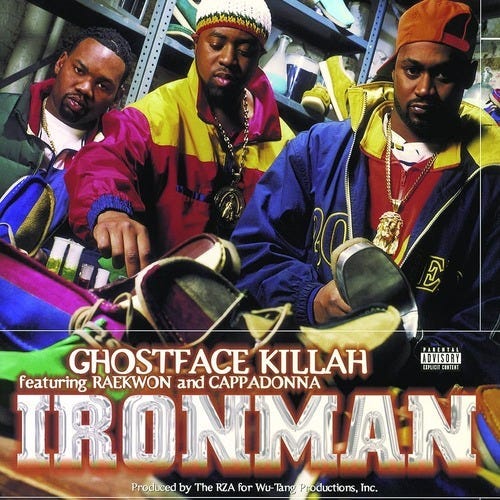
Originally published 9/22/24 on Medium.
To begin grasping the multitudes of Ghostface Killah, the Wu-Tang Clan’s enigmatic once-masked avenger, one must be familiar with the mythology of Iron Man.
In the iconic Marvel comic series, scientist and weapons manufacturer Tony Starks is captured in a war zone. His heart is irreparably damaged by shrapnel. To sustain his heart and break free from captivity, Starks builds a high-tech suit of armor. Once free, he continues to enhance the suit, which eventually provides him powers of superhuman strength, flight, and energy projection. Stark’s Iron Man is the ultimate self-made superhero.
With his solo debut, Ghostface channels Starks — both in name and ethos. Ironman finds Ghost careening through a madcap collection of pulse-pounding episodes. In totality, they capture the duality that makes superhero mythology so endlessly fascinating. He’s at once bombastic and reflective, steely and shattered. He’s equal parts impenetrable armor and cripplingly scarred heart.
The Wu-Tang lyrical marvel opens his first feature with a flurry of action. “Iron Maiden” raises the curtain on Ghost and his fellow Avengers, Raekwon, and Cappadonna, suited, zooted, and ready to risk it all as they race through a high-stakes caper. The parallel motifs of extralegal scores and musical ones invite easy comparisons to Raekwon’s 1995 opus Only Built for Cuban Linx, on which Ghost rode shotgun.
But where the earlier album’s do-or-die hustles were born of desperation, “Iron Maiden”’s lyrics are laced with nods to a life of luxury, suggesting Cuban Linx’s big score succeeded. The duo are still at it out of greed, habit, or an insatiable adrenaline jones. With its pulsing drums, thick bass, ’70s soul horns, and spaghetti western guitar, RZA’s production resurrects Cuban Linx’s immediacy after a detour into abstraction on GZA’s Liquid Swords. Yet, it shimmers with a pristine richness, suggesting the Wu-Gambinos have, indeed, come up in the world.
The album’s first half careens frenetically to and fro as Ghost and his co-Ds put their respective super-powered exoskeletons through their paces. “260” lands in the war room and the battlefield while Ghost and Rae plan and execute the robbery of a notorious drug spot. The track spotlights the dynamic duo at the height of their powers as characters and narrators. Trading verses over RZA’s regal horns, the pair creates a world of colorful characters while methodically mounting the tension with every detail. The set-up’s meticulousness makes the climax’s brutality all the more bracing.
“Winter Warz” spotlights Ghost, Cappa, U-God, and Masta Killa waging lyrical warfare with bars constructed every bit as exactingly as “260”’s heist. Boasts pair the cerebral with the savage as the four MCs dismantle opponents’ body, mind, and spirit. While Ghost’s vocal ferocity ups the ante, it’s Cappadonna who rolls out with the chips, tearing through 54 bars of lethally controlled bravado.
“Wild Flower” transfers the same brutality to affairs of the heart. The result is a break-up song that obliterates the lines between catharsis and toxicity. A tsunami of rage, lust, and psycho-sexual pathos, “Wild Flower” deftly uses a soured relationship to provide our first glimpse at the scar tissue calcifying a heart hardened by the horrors of warfare. To a warrior, the song underscores that even love is a war. Yet, the intensity of the song’s hurt hints that beneath the scars, there’s still a purity to Ghost’s iron heart.
It’s that purity, paired with his unbridled passion, that, over time, has made Ghostface perhaps hip-hop’s most unlikely balladeer. He’s a reliable practitioner of oddball love songs as heartfelt as they are cognitively dissonant. “Camay” marks the first entry into Ghost’s quiet storm chamber. Landing just past Ironman’s midpoint, the idiosyncratically soulful seduction suite finds the album’s core three in a disarmingly earnest quest for connection. Toning down his signature bombast, Ghost pitches woo like an old-school gentleman:
Your complexion gives a reflection of
Sometime a Black woman just need to be loved
Quiet and shy; baby girl, my gift got you high?
Made you wanna hit me with the keys to that 5?
Just jokin’, baby; I have a sharp sense of humor
Wish I would’ve bumped into your frame a lot sooner
His understated delivery carries sufficient sincerity that the song’s ultimate reveal — that he’s creeping on wifey — delivers a moment of whiplash. Fittingly, the song backslides into lusty come ons as it rounds into its final bars. It’s as if Ghost has recognized his own vulnerability and hastily stepped back into his armored suit.
If Ironman’s front half is an audio action flick, the back half subtly shifts to the gritty origin story. RZA’s epic theatricality gives way to a pensively soulful brand of vérité. The rhythmic bassline and cascading drums of the classic single “Daytona 500” lend a bellicose bite to Ghost, Rae, and Cappa’s now familiar brand of braggadocio. Yet, the B-Side’s more straightforward production truly shines when Ghost takes down the armor to offer vividly drawn vignettes of the battlefields that forged him.
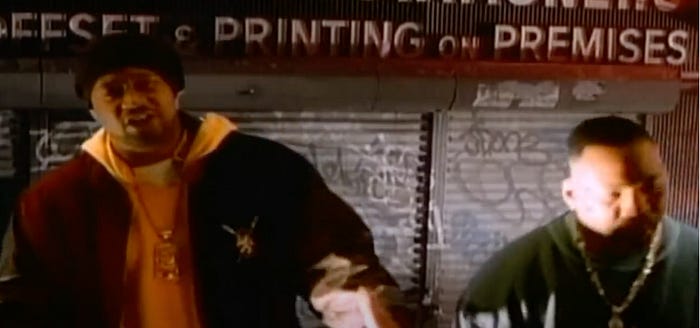
Ghostface and Raekwon, “Motherless Child” music video (1996). Image from Razor Sharp/Epic Records
“Motherless Child” pairs a sorrowful vocal sample from O.V. Wright’s ’60s classic of the same name with an ominous bassline and punishing drums. The result is a dystopian backdrop for Ghostface’s masterfully crafted tale of trauma, greed, and revenge. The theme—money and pride turning childhood friends into mortal adversaries—is well-trodden ground. Ghost, however, displays a novelist’s eye for detail and character, bringing fresh immediacy into the tragedy.
The story’s central character is sketched with such specificity that we empathize even as he sells drugs and draws down in a petty movie theater beef. It makes the plot twist, in which Ghost steps from his role as passive narrator and into the story as the young man’s robber, hit us almost as hard as it does the bystanders witnessing the scene unfold as he shoots his way out of Brooklyn’s famed Albee Square Mall.
On the tear-jerking hit “All That I Got Is You,” Ghost turns the tables. Stepping fully out of his armor, he details the childhood struggles that shaped him and the maternal love that saved him. RZA deploys a minimalist arrangement, allowing the plaintive strings and keys to cradle Ghost like a cocoon as he spills every ounce of his soul into a delivery that spans the full emotional spectrum, sometimes simultaneously.
And there was days I had to go to Tech’s house with a note
Stating, “Gloria, can I borrow some food? I’m dead broke”
So embarrasin’, I couldn’t stand to knock on they door
My friends might be laughin’, I spent stamps in stores
Mommy, where’s the toilet paper? “Use the newspaper”
“Look, Ms. Rose gave us a couch.” She’s the neighbor
Things was deep, my whole youth was sharper than cleats
Two brothers with muscular dystrophy, it killed me
But I remember this, moms would lick her finger tips
To wipe the cold out my eye before school with her spit
In the space of three movements—Ghost’s stream-of-consciousness reminiscence, Mary J. Blige’s soulful lament from his mother’s perspective, and Papa Wu’s philosophical resolution—we understand both the scars that hardened Ghost’s heart and the irrepressible humanity that has sustained it against the longest of odds.
As Ironman rounds into its final lap, listeners could be forgiven for feeling disoriented if thoroughly exhilarated. It’s as if we’re watching a movie overstuffed with compelling scenes but short on thematic throughlines to tie it all together. Remarkably, “The Soul Controller” succeeds not only as an epic capstone but in providing that very connective tissue.
RZA delivers a tour de force, interweaving the cinematic exoticism of the A-Side tracks with the hard-driving soul dirges of Side 2. The chorus features an extended recreation of “A Change Is Gonna Come,” sung with hauntingly atonal anguish by the Force M.D’s. The vocals languish at the cross-section of the album’s recurring emotions—pain, desperation, defiance, resilience.
Ghost uses the first verse to deliver the preamble conspicuously absent at the album’s start. His matter-of-fact depiction of his imprisonment at the intersection of desperation and aspiration provides a methodical explanation of what inspired the high-stakes heists through which we first met the inner-city Avengers.
Yo, yo these streets got me backed down, how can I escape?
How can I survive without bubblin’ weight?
It’s prepared for the stand off, once you hand off
That white rock, and then give birth to a knot
Your biggest dream was to rock your 850 and beam
You and the Gods buy a crib in the white part of Queens
But at the same time, n****s on the block is ill
Some’ll rock you to sleep, hap, for selling crushed pills
Being watched all day like enemies’ prey
Faces you never seen before is in your hallway
Brothers you knew for years is mad p**** and scared
Back in the days, U.F.O.’s couldn’t walk up in here
It’s time to motor, travel like a foul order
Clear my head, stay sober, the soul controller
The second verse contrasts the visions of intellectual and spiritual enlightenment that motivate Ghost’s maneuvers with the brutality of the world he must navigate to get there. Ghost concludes the song and the album with a concise third verse in which imagery of street savagery morphs into defiant MC boasts. It plays as a definitive reminder that having weathered the war, armor intact, the only product he’s now pushing is his lethal pen.
Carbon copy, I love my Akai snare choppy
Melachi off the funky pen with the wax poppy on instrumentals
Like his comic book doppelganger, Ghostface Killah has made the transition from mercenary to prisoner of circumstance to righteous warrior; he and his Clan “play[ing] the wall like nine superheroes.”
In a 2021 appearance on Noreaga’s Drink Champs podcast, Ghostface confessed to not liking Ironman. He admitted to suffering from depression during its recording, which made writing and creating a struggle. Understandably, Ghost wouldn’t care to revisit those dark feelings. Yet, it’s hard not to suspect that, like Tony Stark’s trauma, that darkness gives Ironman much of its power.
Unlike previous Wu-Tang solo albums, Ironman moves beyond the Wu-Tang philosophy. It presents Ghostface as achingly human rather than simply expounding on his persona within the group mythology. That humanity is at the heart of Ghost’s sustained success as a solo artist long after many of his fellow Clansmen faded.
Ironman mesmerizes with its armored adventures. Its true triumph, however, lies in its fearless willingness to take us beneath the armor, where we meet a man of true steel.
By the Numbers
Production: 10
Lyrics (how the words are put together): 9
Delivery & Flow: 9.5
Content (Substance): 9
Cohesiveness: 8
Consistency: 9
Originality: 9.5
Listenability: 9
Impact/Influence: 8
Longevity: 9
Total — 90
Score reflects the tracklist for original LP and cassette pressings. CD and digital versions contain a bonus track, “Marvel”. Later editions omit “The Soul Controller” due to sample clearance problems. It has thankfully been restored on the 25th anniversary special edition.
Backspin is a look back at the albums that shaped and defined hip-hop. It explores what made them resonate, the impact they had on the culture, and where they fit in today’s ever-expanding hip-hop canon.