Backspin: Eazy-E — Eazy-Duz-It (1988)
Gangsta gateway. (86/100)

Originally published 9/8/24 on Medium.
Seven simple words opened a floodgate:
“Cruisin’ down the street in my six-fo’”
It wasn’t that “Boyz-N-The-Hood” unleashed gangsta rap on the world. With its whimsical delivery of vivid street vignettes, Eazy-E’s landmark 1987 single followed closely in the mold of proto-gangsta predecessors, like Schoolly D’s “Saturday Night” and Ice-T’s “6 in the Mornin’”. “Boyz-N-The-Hood” swung the gate in the opposite direction, inviting the world into gangsta rap.
“Boyz-N-The-Hood” is a shining example of the whole amounting to exponentially more than the sum of its parts. The raw simplicity of the minimalistic 808 beat paired with Eazy-E’s Mother Goose cadence ultimately proved the record’s greatest asset. Not only did it place the focus squarely on the world that Eazy was building, the repetitive rhythm and elementary rhyme schemes invited listeners from all walks of life to rap along.
The participatory element quickly transitioned the uninitiated from rubbernecking interlopers to enthusiastic co-conspirators in the gangsta underworld that would soon commandeer hip-hop and popular culture. As listeners rapped along, they absorbed the lingo, cultural signifiers, and attitude integral to understanding and exalting the more sophisticated gangsta rap soon to come.
Cruisin’ down the street in my six-fo’
Jockin’ the b****es, slappin’ the hoes
Went to the park to get the scoop
Knuckleheads out there, cold shootin’ some hoops
A car pulls up, who can it be?
A fresh El Camino rollin’ — Kilo G
He rolled down his window and he started to say
“It’s all about makin’ that GTA”
’Cause the boys in the hood are always hard
You come talkin’ that trash, we’ll pull your card
Knowin’ nothin’ in life but to be legit
Don’t quote me, boy, ’cause I ain’t said s***
The triple-platinum success of Eazy’s group, N.W.A, and their explosive debut, Straight Outta Compton, surpassed “Boyz-N-The-Hood” stylistically and commercially the following year. Yet, the importance of Eazy-E’s single in priming audiences for N.W.A and the avalanche of disciples that followed can’t be underestimated.
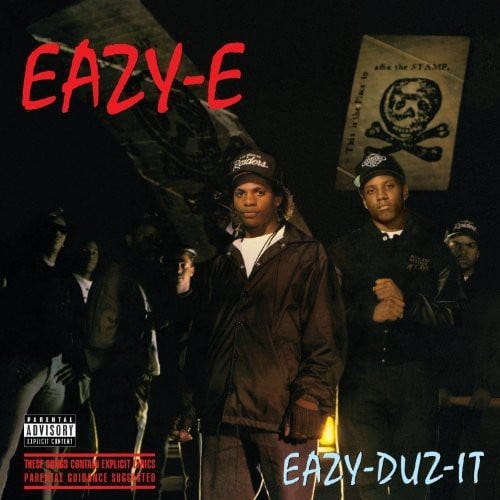
It’s only fitting that mere months after Straight Outta Compton shook up the culture, Eazy brought the journey full circle. Eazy-Duz-It refines the formula established by “Boyz-N-The-Hood” to flesh out not only Eazy’s world, but his persona as its most colorful character.
It was Eazy-E’s persona, heightened by a helium-textured cartoon voice, that lent Straight Outta Compton much of the tongue-in-cheek levity that cut N.W.A’s snarling aggression just enough to broaden the group’s accessibility. Eazy-Duz-It wastes no time in leaning into the madcap mischief that made Eazy Straight Outta Compton’s initial breakout star despite far less mic time and technical acumen than N.W.A’s lead rappers, Ice Cube and MC Ren.
Funk-fried opener “Still Talkin’” finds Eazy flexing his bona fides as the ultimate street signifier. Over a muscular bass and guitar loop from Rudy Ray Moore’s “The Night Before Christmas and Others,” Eazy regales with tall tales of sexcapades that would make Moore himself blush. Like Moore’s iconic 1970’s comedy, Eazy’s freaky tales are so over-the-top that the sheer absurdity dilutes the misogyny.
As a table setter, “Still Talkin” establishes that, unlike N.W.A’s bracing street narratives and revolutionary defiance, Eazy-E isn’t meant to be taken literally or particularly seriously. Between verses, Dr. Dre deploys explosive horns from Rufus Thomas’s “Do the Funky Chicken.” Atop the sample, a riotous peanut gallery eggs Eazy on as his tales grow taller. If there was any doubt, the jarring interludes yank back the curtain on the fact that this is not Ice-T’s “reality rap.” It’s a show — a heightened spectacle of funhouse gangsterism.
As Carnival commences, we’re primed to receive the album’s most macabre moment, “Nobody Move,” as shenanigan rather than sadism. Even as Eazy details a robbery rife with superfluous brutality, his childlike voice and impish whimsy evoke an angel-dusted Dennis the Menace more so than a gang-affiliated Charles Manson.
Though the ribald second verse would elicit immediate calls for cancellation today, the Shyamalan-worthy plot twist proves a narrative masterstroke, undercutting Eazy’s depravity by making him the story’s ultimate dupe. That he’s willing to deliver one of the album’s biggest laughs at his own expense further peels back the mask of bravado that kept some at arm’s length from gangsta rap’s more self-serious iterations.
The inclusion of the year-and-a-half old “Boyz-N-The-Hood” in an extended remix form introduces newcomers to the origin of Eazy, N.W.A, and by extension their distinctly southern California brand of gangsta rap. A verse is added as prologue, setting up Eazy’s re-rapping of the song, peppered with additional splashes of profanity to solidify the sea change signaled by Straight Outta Compton.
Following an intro in which his groupmates egg him on to bust that “crazy s***” that “motherf***ers said wasn’t gonna work,” Eazy tears into the new verse, soundtracking a day in his gangsta life with the song we’re about to hear.
Jumped in the ‘4, hit the juice on my ride
I got front and back, and side to side
Then I let the Alpine play
Bumpin’ new s*** by N.W.A
It was “Gangsta Gangsta” at the top of the list
Then I played my old s***, it went somethin’ like this
It’s a deft approach to including the familiar favorite in a way that feels fresh while positioning it as a classic of the still nascent subgenre. By doing so, Eazy acknowledges and embraces the single’s sonic crudeness in comparison to the album’s newer compositions, which begin to introduce the rich musicality that would become a hallmark of later gangsta rap.
Dr. Dre’s production steals the show on the title track, expertly corralling a bacchanal of sound. A whirling dervish of explosive samples, robust live instrumentation, and DJ Yella’s crisp turntablism, “Eazy-Duz-It” is the most pronounced example of Dre’s approach to much of the album: leveraging sonic dynamism to provide the momentum that Eazy’s static and often stilted delivery can’t.
It’s quite possible that constructing Eazy-Duz-It around Eazy’s limitations — multiple N.W.A members have spoken of Dre having to record each of Eazy’s lines individually and manually assemble his verses due to Eazy’s inability to stay on beat — was integral to Dr. Dre’s evolution from elite beat maker to master producer. Though heavily sample-driven, many of Eazy-Duz-It’s standout tracks are meticulously arranged rather than simply leaning on looped breakbeats.
“We Want Eazy” finds Dre taking his first deep dive into the P-Funk waters that would eventually become his lifeblood. Using live musicians, including frequent collaborator Stan “The Guitar Man” Jones on guitar and bass, Dre and Yella recreate Bootsy’s Rubber Band’s “Ahh… The Name is Bootsy, Baby” as the backbone of a party anthem equally suited to rock a backyard barbecue or an unsanctioned back ally night spot.
Taking its cue from Bootsy’s original, the track leans heavily into Eazy’s roguish persona, leaving the gangsta bravado largely in the subtextual shadows. As a result, “We Want Eazy” became one of the first gangsta rap hits to achieve daytime radio play, beginning the erosion of barriers between gangsta rap and mainstream media. It also provided a template for the “gangsta party” records that would become a hip-hop staple for decades to come, catapulting subsequent artists like Snoop Dogg and 2Pac into superstardom.
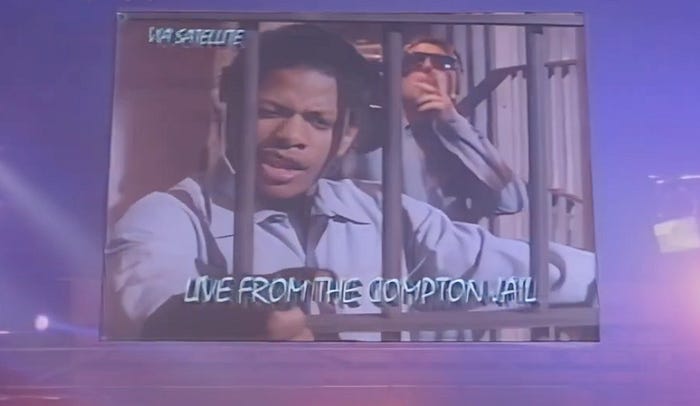
“We Want Eazy” music video, 1989. Image from Ruthless/Priority Records.
In many ways, Eazy-Duz-It plays as an N.W.A offshoot as much as a solo introduction. In addition to Dr. Dre’s role as the album’s sonic architect and Yella’s turntable and percussion work, Ice Cube, MC Ren, and frequent N.W.A collaborator The D.O.C. tag team to pen Eazy’s verses. (Eazy-E was not a rapper before joining N.W.A; he was a financier with a voice that sounded irresistibly demented when spitting gangsta rhymes.)
All three MCs prove equally stellar in crafting rhymes to match and build upon Eazy’s persona. Ren, however, emerges as the perfect partner in rhyme and crime. Taking on a role somewhere between hype man and co-defendant, Ren’s muscular baritone and dexterous flow prove the ideal counterpoint to Eazy’s voice and delivery. His presence grounds “Ruthless Villain” and “2 Hard Mutha’s,” and he ably plays Bobby Byrd to Eazy’s James Brown during intros and between verses on several other standouts.
Had the malfeasance of Eazy and manager Jerry Heller not splintered the crew, it’s easy to imagine N.W.A having evolved into an entity similar to mid-90s Wu-Tang Clan: each member releasing a quasi-solo project built around his specific persona, but bolstered by the entire collective.
Ren was seemingly up next, and probably the biggest loser in the split. As arguably the best pure rapper but the least distinctive personality among N.W.A’s MCs, his eventual solo career failed to gain the traction of his cohorts. A Dre-produced solo under the N.W.A umbrella, with Eazy riding shotgun, might have been just the formula Ren needed to achieve individual stardom.
Eazy-E’s star power, however, never dims throughout Eazy-Duz-It’s brisk 50 minutes. Whether brashly retrofitting his bravado for the airwaves and daring programmers to ignore gangsta rap’s rising tide (“Radio”) or offering a Q&A on the machinations of the culture behind the milieu (“No More ?’s”) the unerring brashness of Eazy’s swagger makes him an irresistible anti-hero.
He’s the perfect conduit into the world of gangsta rap, preternaturally suited to filter its brutality through a kaleidoscope that renders it thrilling rather than threatening. At the heart of Eazy-Duz-It lies the blueprint for hip-hop characters of subsequent generations, from Snoop to Lil’ Wayne to Young Thug, who built empires atop the marriage of inner-city angst and cartoon color.
Was Eazy-E a great MC? Of course not. It’s entirely possible he never wrote a word that passed his lips in the entirety of a career cut tragically short by his 1994 death from AIDS.
But he’s the epitome of a rap star. With a little help from Eazy’s friends, Eazy-Duz-It proved to an industry still skittish about hip-hop in general, and its hardcore varieties in particular, that gangsta and stardom could not only co-exist, but resonate with audiences far beyond the boys in the hood.
By the Numbers
Production: 9.5
Lyrics (how the words are put together): 6
Delivery & Flow: 6.5
Content (Substance): 8
Cohesiveness: 9
Consistency: 9
Originality: 9
Listenability: 9
Impact/Influence: 10
Longevity: 10
Total — 86
Backspin is a look back at the albums that shaped and defined hip-hop. It explores what made them resonate, the impact they had on the culture, and where they fit in today’s ever-expanding hip-hop canon.
My most memorable quote from…
“Eazy… why do you wear your pants like that?” Michel’le
“For Eazy access baby!!!” Eazy-E
“We Want Eazy”
https://youtu.be/n1wNssbChCI