2004: The Year the Streets Went Digital (Part 2) — The Mask and The Wire
MF DOOM, Kanye West, and the culmination of message board mythology

Originally published 10/26/25 on Medium.
2004 was the year hip-hop’s underground infrastructure moved from concrete sidewalks to fiber optic pathways. In Part One we explored the new generation of voices that emerged from digital message boards and the veterans who found new life on those same forums.
However, 2004 also saw the culmination of long and winding journeys for a singular artist who embodied the internet, and another who remixed the message board zeitgeist to the top of the charts.
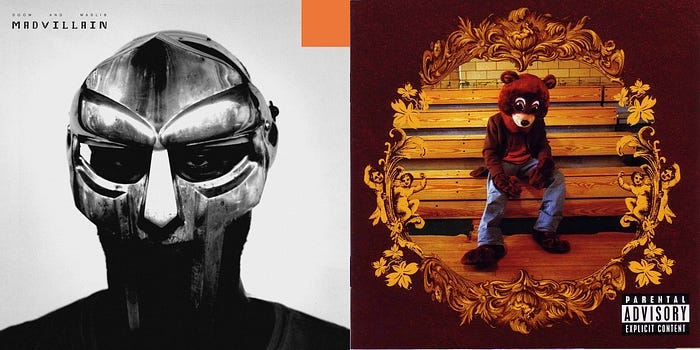
The mask and the mythos: the digital reinvention of MF DOOM
It’s fitting, even poetic, that after 15 years and two identities, 2004 was the year Daniel Dumile finally tipped. Dumile’s MF DOOM incarnation was, in many ways, the internet personified. His lyrics were densely packed with pop culture obscurities. They were delivered with a flat detachment belying their intricacy. His production was proudly lo-fi. It was stitched almost entirely from digitized tapestries of moments long forgotten by most but passionately treasured by select aficionados.
He literally performed behind a mask.
Introduced to the world as Zev Love X on 3rd Bass’s 1989 hit “Gas Face”, Dumile spent the remainder of the 20th Century as a man in search of a country. His group, KMD, released its first album, Mr. Hood, in 1991. Despite light rotation on Yo! MTV Raps, but the project was largely lost in a jam packed, if schizophrenic year. The group’s jazz-tinged production and Dumile’s off kilter-flow didn’t groove quite fluidly enough to match the infectious dynamism of the Native Tongues. The lyrics, while conscious, lacked the fervor to cut through the fire and brimstone of hip-hop’s revolutionary guard.
In an alternate timeline, KMD’s 1994 follow-up, Black Basterds, may well have been its breakout moment. With a rumored rave review in The Source ready for the presses, the project was shelved by Elektra Records at the 11th hour. The label stated concerns about the album’s provocative cover art — a cartoon “Sambo” figure being lynched. However, persistent rumors suggested the image simply provided convenient cover for Eletktra to wash its hands of a group it didn’t know quite what to do with.
Even more painfully, Dumile’s brother and group-mate, Dingilizwe (DJ Subroc), was struck by a car and killed around the same time.
Broke, depressed, and nearly homeless, Dumile re-emerged at New York area open mics in 1997. Rather than trading on what remained of his KMD fame, he performed in a mask under the Metal Face DOOM moniker. The MF DOOM character was styled as a comic book villain vowing revenge on “the industry that so badly deformed” him. DOOM released three albums between 1999 and 2003, gradually building a cult following through college radio and the embryonic internet. In 2004 the stars aligned. Dumile fully found his MF DOOM voice just as the infrastructure to amplify it reached critical mass.
Madvillainy, DOOM’s collaborative concept album with producer Madlib, is in many ways, the Illmatic of the internet era. Released a decade after Nas’s 1994 debut, Madvillainy signaled a similar paradigm shift. Where Illmatic marked a pivot from the Golden Era’s external focus on rocking parties and fighting the power to intimate personal introspection, Madvillainy shape-shifted introspection into internal world building. Hyper realism gave way to symbolic abstraction. Illmatic was grounded in humanity; Madvillainy elevated through mythology. Illmatic felt communal, ushering in an era of all-star production-by-committee. Madvillainy shined in the hypnotic intimacy of a single-producer showcase.
The end result was, perhaps, the first hip-hop album that could only thrive on the internet. It’s layered, fragmented, and aggressively idiosyncratic. It’s not built to rock the party, rumble in the trunk, or groove on the stoop. It’s a headphone masterpiece meant to be rewound, dissected, and decoded. Unraveling Madvillainy’s linguistic and sonic intricacies became both a right of passage and a community building exercise for message board mavens the web over.
With fans still deciphering Madvillainy, DOOM closed out the year with a second opus, MM..Food. True to its name, the largely self-produced project uses food as both metaphor and conduit to exploration of, well, everything. It’s delivered with a mix of whimsy and reflection belied by DOOM’s unhurried monotone.
MF DOOM’s 2004 marked a blueprint for navigating the digital streets. Raw, but intricate sample-forward production mixed for headphone excursions rather than car speakers. Dense lyricism lending itself to solitary listening and communal mythologizing. And, perhaps most importantly, a rapid fire release schedule that keeps fans (and threads) fed.
The digital streets go West (Kanye, that is)
Kanye West’s myth-making was every bit as intricate as MF DOOM’s. But where DOOM thrust his character construction front and center, Kanye hid his in plain sight.
In the early 2000s, Kanye West had far more in common with Little Brother’s Phonte than he did with Jay-Z. Both men were former college kids who had left school early to pursue a passion for hip-hop. They displayed immense talent, but didn’t fit the mold for rap stardom.
Beneath the scrappy everyman exterior, however, Kanye was playing a different game. Having grown up in a major city with a robust but not over crowed hip-hop scene (Chicago), his early mixtapes achieved a physical footprint beyond the scope of what Little Brother could achieve in Durham. His status as a double threat (rapper and producer) enabled him to secure a foothold in the industry as a beatmaker, and eventual in-house producer for Jay-Z’s Roc-A-Fella Records.
By 2004 Kanye was an A-list producer, and almost certainly a multi-millionaire. Industry power brokers still showed little interest in placing him in front of a microphone. But he wasn’t a pugnacious underdog clawing at the closed doors of an impenetrable industry. He was already firmly ensconced in it — just not quite in the way he wanted to be.
Kanye’s 2004 debut album, The College Dropout, did tell his story. At times quite passionately. That gave it enough authenticity to resonate with the message board crowd, who had been circulating leaks of unfinished tracks for months. But it was told with the benefit of hindsight. Kanye already knew how the story played out, affording him the granular view to craft his struggle rhymes as a hero’s journey rather than diary entries from the frontlines.
And everybody, from message board power users to casual of Top 40 listeners, loves a good hero’s journey.
A near-fatal 2002 car accident gifted Kanye precisely the narrative to elevate his story to super-hero level origin myth. In perhaps the first definitive “Kanye moment,” West immediately saw through the trauma to the marketing opportunity. Jaw still wired shut, he raced from the hospital to the studio to record “Through the Wire”.
To today’s ear, the song itself is unremarkable — a sped up Chaka Khan sample over an otherwise stock beat and rhymes that sound very much like they were delivered through a wired jaw. But as mythology, it resonated as a near DOOM-like solidification of character. It positioned Kanye, already gathering moment on digital forums, as “the chosen one,” overcoming not only industry barriers, but mortality itself to bring the world his story. It differentiated Kanye from his message board peers, while aligning him firmly in their tradition. If Little Brother, Murs, and Jean Grae reflected their listeners’ present struggles, Kanye embodied the prospect of triumph on the other side.
After months of digital ubiquity, radio picked up the frequency and “Through the Wire” landed Kanye into mainstream rotations. The song’s success essentially forced Roc-A-Fella’s hand, fast tracking The College Dropout onto 2004’s first quarter release schedule.
In hindsight, it’s easy to see that what separated Kanye from his message board peers was a calculating cultural fluency mixed with a near-pathological thirst for superstardom. He was never fully of the message board world. But, he was adjacent enough to be fluent in its language. If Phonte embodied the digital room and DOOM galvanized it, Kanye read it like an instruction manual. He did the same with the mainstream world to which Roc-A-Fella granted access. Whether through calculated strategy or savant-like instinct, he identified the former as an emerging path to the latter.
As a result, the true genius of The College Dropout was not the music. It was that it made sense of the contradictions that defined early 2000s hip-hop. Kanye brought the cinematic scale of his Roc-A-Fella work to the dusty soul sample aesthetic of the digital streets. The themes — insecurity, existential uncertainty, crises of faith — were straight off the message boards. But the presentation — ostentatious, self-aggrandizing, larger than life — was mainstream rap star branding at its brashest.
The 21st Century conduit
The College Dropout sold nearly four million copies and garnered 10 Grammy nominations. That the biggest mainstream album of 2004 was a product of message board culture is the perfect encapsulation of the year the streets went digital. It also foreshadowed what would become the 21st Century’s de facto path to mainstream stardom. As message boards gave way to blogs, and eventually social media, today’s biggest names — Kendrick Lamar, Drake, J. Cole, Tyler the Creator, Cardi B — all built their initial buzz largely online.
Even Westside Gunn’s Griselda collective, through which Benny the Butcher reached stardom, while undecidedly “street” in substance, is a largely digital phenomenon. The streets might stream the odd song. But it’s the digital natives — Benny’s “weird Twitter nerds” — who drop $50 for limited edition vinyl and $100 for hoodies at shows. Does Benny really think hustlers and corner boys are running home to argue on Twitter about the best mixtape in his Plugs I Met series?
So when Benny says “the streets don’t hold the culture no more,” he’s right in the literal sense. But, the streets’ status as the driver of hip-hop music arguably ended in the early 80s. Once record labels began signing rappers at scale, the hottest MC was no longer determined by who rocked the hardest block parties or reigned supreme in corner cyphers. It was determined by who made the right record, with the right push, at the right time.
Once stardom became the barometer of success, MCs had little choice but to work inside the machine to varying degrees. Sign with the wrong label, piss off the wrong media programmer, or wear the wrong sweatsuit in a video, and MCs risked being relegated to “cult favorite” while better positioned peers reaped the benefits of stardom. Artists like Too $hort, E-40, and Ludacris became regional legends selling their music hand-to-hand on the streets. But they were virtually unknown nationally until they signed or partnered with major labels.
The internet effectively made the streets global. They enabled MF DOOM to amass an international following legion enough to sustain him through ticket and merch sales until his death in 2020 despite his records never receiving a single corporate radio spin. The digital streets turned small pockets of fans scattered throughout the world into cohesive communities fervently devoted to celebrating and amplifying their artists.
So it’s not that hip-hop left the streets. The streets simply migrated. In doing so, they got bigger, stronger, and better organized. That’s a win by any measure. And it’s the central truth behind 2004’s legacy as one of hip-hop’s most transformative years.
Really love this man big up!
Hip-Hop Already Wrote the Script: Why Marvel Should Use MF DOOM as the Blueprint for Doctor Doom https://ajwoodson.substack.com/p/hip-hop-already-wrote-the-script?r=g8abi&utm_campaign=post&utm_medium=web&showWelcomeOnShare=true